
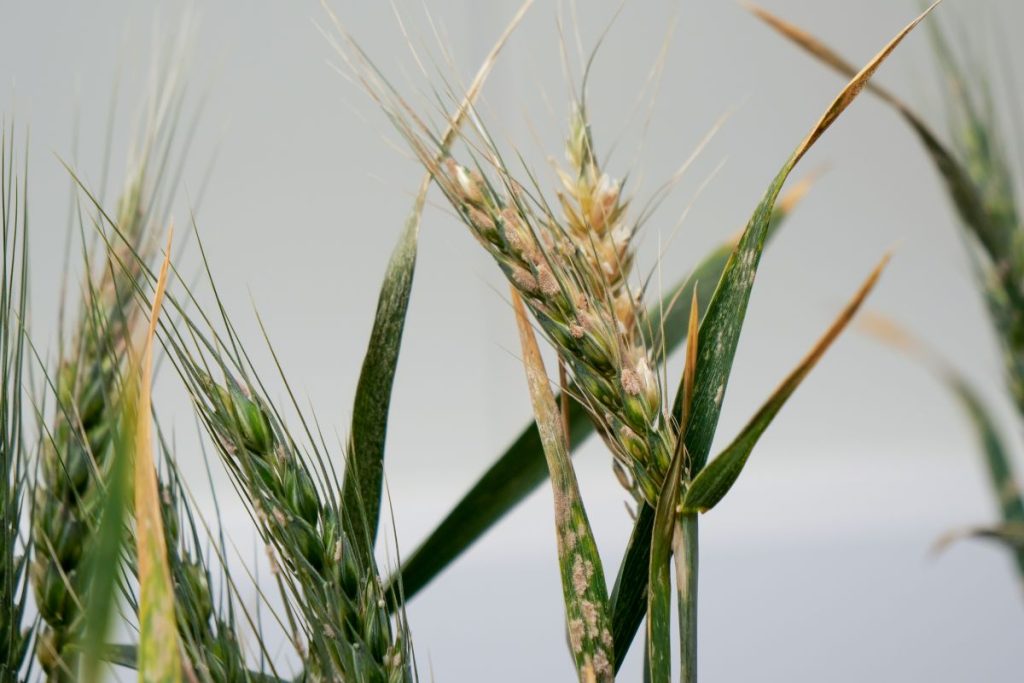
With fungicide resistant wheat powdery mildew now detected across much of Australia, researchers at the Centre for Crop and Disease Management (CCDM) have identified promising sources of genetic resistance that could help breeders develop more resilient wheat varieties for growers.
In recent years the fungal disease, caused by pathogen Blumeria graminis, has become a major challenge for growers. Control has become limited due to the rapid spread of fungicide resistance in most Australian states, severely limiting management options.
A collaboration between CCDM and Australian crop breeding company InterGrain, focused on the complexity of these pathogens across Australia and the identification of potential sources for resistance genes.
The discovery has led to a project at the CCDM, with co-investment by the Grains Research and Development Corporation and Curtin University, that will build on this groundwork to assess these resistance sources for use in future wheat breeding programs.
The study was recently published in scientific journal Crop & Pasture Science by PhD student Ancy Tony.
“By testing wheat powdery mildew isolates collected from across Australia against 24 wheat lines carrying known powdery mildew resistance genes, we could assess not only the diversity in this disease across the country but also test which resistance genes are still effective,” Ms Tony said.
“This pathogen population is not dominated by just one strain, but has substantial variation, meaning we can’t rely on just one resistance gene alone to control this disease.”
The most promising finding from the study was the identification of effective resistance in wheat lines which may contain additional resistance genes for breeders to utilise.
“We found that the wheat lines Khapli and Tabasco were highly resistant to all isolates of the disease, making them a valuable resistance source for breeders,” said Ms Tony.
Khapli and Tabasco contain previously identified resistance genes, but CCDM researchers believe they may also carry additional genes that are yet to be detected but could be pyramided to ensure long lasting resistance.
“There were also three additional European varieties which showed promising resistance against the Australian isolates of wheat powdery mildew, so they may carry more durable, broad-spectrum resistance that we are yet to utilise,” explained Tony.
CCDM Project Leader Associate Professor Kar-Chun Tan (KC) says the project aims to understand the disease which will help improve wheat’s resistance, therefore reducing the industry’s reliance on fungicide treatment.
“Since the best way to prolong the impact of fungicide resistance is to grow varieties with stacked resistance genes, there’s an urgency to work with breeders to find better options for growers.
“This project will identify genes that are effective against wheat powdery mildew and determine how
they can be combined to deliver more durable resistance. It builds on the combined expertise of CCDM’s Cereal Diseases and Fungicide Resistance themes, together with national and international partners. By bringing these capabilities and resources together, we’re in the best place to tackle this problem”
CCDM Director Professor Mark Gibberd says this collaborative study with InterGrain and its subsequent evolution into a new research project demonstrates the value of industry partnerships in research.
“This recent study has identified several highly promising sources of resistance against wheat powdery mildew, and we’ve been able to leverage these outputs and capabilities to create a strong foundation for the next stage of research,” Professor Gibberd says.
“By collaborating with breeding companies and integrating them into our research process, we can ensure our work delivers outcomes that are relevant and valuable to the Australian grains industry.
“These direct industry-research partnerships help bridge the gap between research and application, ensuring our work is informed by industry needs and positioned to deliver impact for Australian growers.”
CCDM is a national research centre co-supported by the Grains Research and Development Corporation and Curtin University.
Read the paper, Virulence complexity of Australian Blumeria graminis f. sp. tritici and implications for resistance breeding.